The 8 Phases of EMDR: What to Expect (From an EMDR Therapist)
One of the questions I get asked most often is:
"So... what actually happens during EMDR?"
Most people have heard of the eye movements, or they've seen a video of someone following a therapist's fingers, but that's only a tiny piece of what EMDR actually is.
EMDR (Eye Movement Desensitization and Reprocessing) is an evidence-based therapy that helps the brain process experiences that have become "stuck." While it's best known for treating PTSD, I also use it with clients struggling with complex trauma, anxiety, panic, low self-worth, burnout, grief, and attachment wounds.
The thing I always want people to know is this:
Good EMDR isn't about diving headfirst into trauma.
A lot of the work happens before we ever process a difficult memory. My job is to help your nervous system feel supported enough that your brain can do what it naturally knows how to do.
Here's a look at the eight phases of EMDR and what they're actually like in practice.
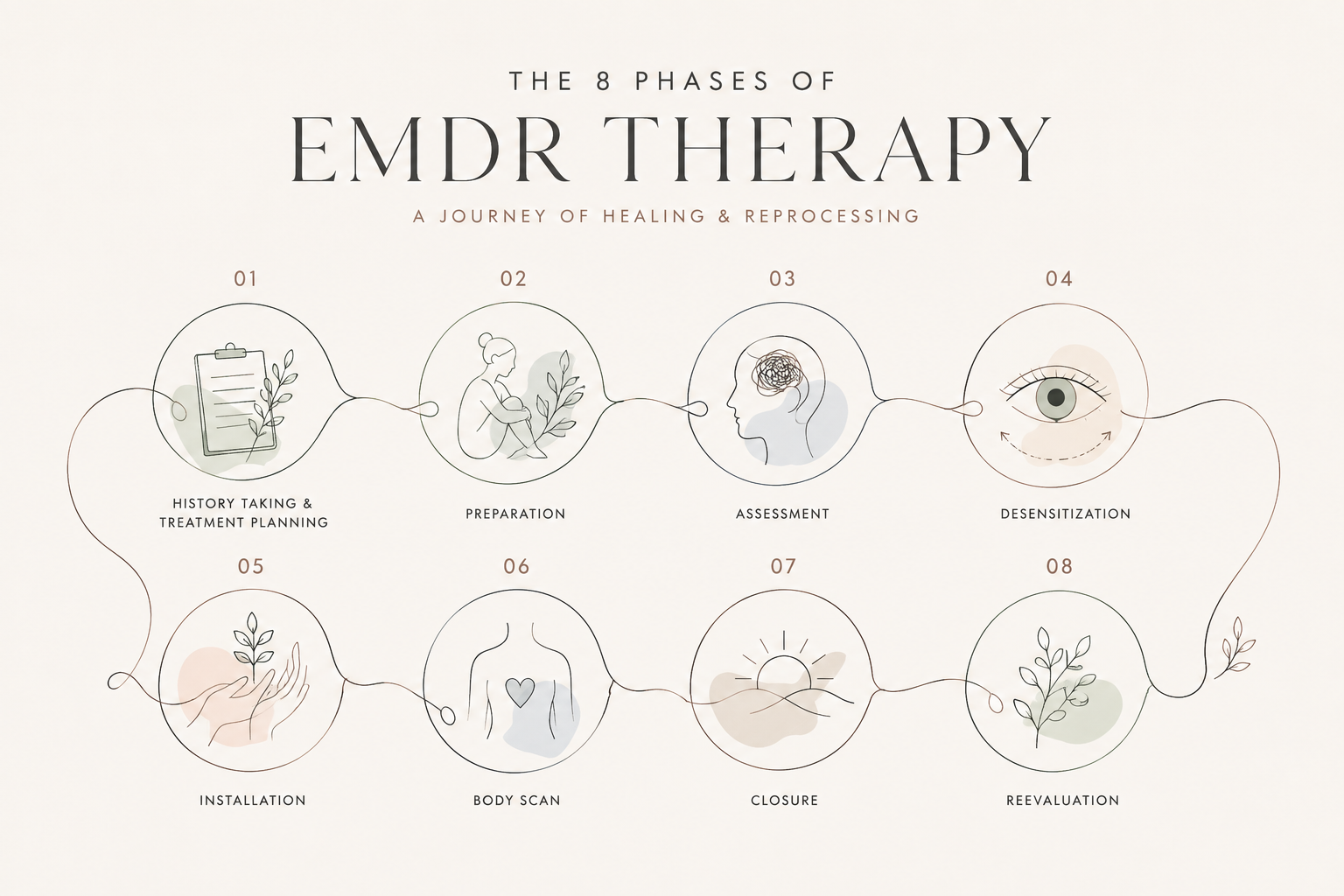
Phase 1: Getting to Know Your Story
The first phase isn't glamorous, but it's incredibly important. Before we jump into anything, I want to understand you as a whole person.
We'll talk about what's bringing you to therapy, what's been happening recently, important life experiences, your relationships, your strengths, what's already helping, and what you'd like to be different.
From there, we start identifying patterns. Sometimes there's one obvious event that stands out. Other times, especially with complex trauma, it's a series of experiences that slowly shaped the way you see yourself.
One thing that surprises people is that we don't always start with the "biggest" trauma. Sometimes beginning with a smaller target helps build confidence and gives your nervous system a chance to experience success before approaching more difficult memories.
Phase 2: Building Resources
If I could clear up one misconception about EMDR, it would be this:
We don't rush into processing.
Honestly, one of my favourite parts of EMDR is the preparation phase because it's where clients start realizing they don't have to white-knuckle their way through healing anymore.
Before we process trauma, we build resources.
Depending on your needs, this might include things like:
A peaceful or safe place exercise
A nurturing or protective figure
Grounding skills
Container exercises for intrusive thoughts
Breathing techniques
Body awareness
Learning how trauma affects the nervous system
Strengthening the ability to stay present
Some clients spend one session here. Others spend months. Neither is better. In fact, I've found that when we slow down enough in the beginning, the processing often goes much more smoothly later on.
Phase 3: Choosing a Target
Once you're feeling ready, we choose one specific memory to work on.
Together we'll identify things like:
The image that represents the hardest part
The negative belief about yourself connected to it
The belief you'd rather hold today
What emotions come up
Where you notice it in your body
For example, someone might discover that underneath years of people pleasing is a belief like:
"I'm not important."
Or maybe:
"I'm not safe."
"I'm too much."
"I'm broken."
Often clients already know these thoughts are irrational. The challenge is that their nervous system hasn't caught up yet. That's where EMDR comes in.
Phase 4: Processing
This is the phase most people picture when they think about EMDR. We'll use bilateral stimulation, whether that's eye movements, tapping, or alternating tones, while you briefly notice different parts of the memory.
One thing I tell almost every client is:
There is no right way to do EMDR.
You don't have to force memories. You don't need to analyze everything. You don't have to perform. Your only job is to notice what comes up. Sometimes clients remember something they hadn't thought about in years. Sometimes emotions shift. Sometimes body sensations change. Sometimes absolutely nothing seems to happen for several sets, and then suddenly everything starts connecting. Everyone's brain processes differently, and that's okay.
Phase 5: Strengthening the New Belief
As the emotional charge around the memory decreases, we begin strengthening a healthier belief.
Maybe it's:
"I am safe."
"I matter."
"I can trust myself."
"It wasn't my fault."
This part is important because trauma often teaches us lessons that simply aren't true. EMDR isn't about pretending bad things never happened. It's about helping your brain update information that got frozen in time.
Phase 6: Checking In With Your Body
One of the reasons I love EMDR is that it doesn't treat healing as something that only happens in your thoughts. Trauma lives in the nervous system too. That's why we'll check in with your body before we finish processing.
If there's still tension in your chest, tightness in your stomach, or another sensation that feels connected, we'll spend some time with it. The goal isn't to force relaxation. It's simply to notice whether your body still feels like the event is happening right now.
Phase 7: Ending the Session
Every EMDR session ends with closure. Whether we've completely finished processing or not, I want you leaving session feeling as grounded as possible.
We'll spend time helping your nervous system settle before you head back into your day. Sometimes we'll use grounding. Sometimes a peaceful place. Sometimes just talking through what came up. I also remind clients that processing doesn't stop the second they leave my office.
It's very common to notice new dreams, memories, emotions, or insights over the next few days. That doesn't mean anything is wrong. It often means your brain is continuing to do the work.
Phase 8: Checking Our Work
At the beginning of the next session, we'll come back to the memory and see how it feels now. Sometimes people are amazed that they can remember exactly what happened but it no longer feels like they're reliving it.
That's one of my favourite moments to witness. The goal of EMDR isn't memory loss. It's freedom. You still know your story. Your story just doesn't have the same grip on your nervous system anymore.
Every EMDR Journey Looks Different
If there's one thing I hope you take away from this, it's that EMDR isn't a race. Some people move through the phases quickly. Others need more time building safety first. Neither means you're doing therapy "better."
As an EMDR therapist, I'm paying close attention to your nervous system, not just the treatment protocol. Sometimes the most therapeutic thing we can do is slow down. Healing tends to happen when your brain feels safe enough to process, not when we try to push it before it's ready.
Thinking About Trying EMDR?
Starting trauma therapy can feel intimidating.
I get it.
A lot of my clients come in worried that they'll have to tell me every detail of what happened or that they'll leave every session completely overwhelmed.
That isn't how I practice.
My goal is to help you process difficult experiences without feeling like you're drowning in them. We move at a pace that feels manageable, and you're always part of the decision making process.
If you've been wondering whether EMDR might be a good fit for you, I'd love to help you explore that.
You don't have to carry everything you've been carrying forever.

About The Author
I’m Jackie Ponomariov, therapist & founder of Me Again Collective. I love to help young adults quiet the chaos, feel less anxiety, build confidence, and feel more control over their own lives. I specialize in EMDR, Somatic Therapy, IFS, DBT, Hypnosis, & more.
Let’s get to know each other! Book a free 15 minute consultation today.